Every time a major company goes public through an IPO, the hype machine goes into overdrive.
Financial media covers every detail. Social media starts buzzing. Investors rush to buy shares. It creates the impression that getting into an IPO is a shortcut to building wealth.
The reality is often much different.
An Initial Public Offering (IPO) is when a private company sells shares to the public for the first time. While anyone can buy shares once trading begins, most investors don’t get access to the IPO price itself.
Those shares are typically allocated to institutional investors, mutual funds, large advisory firms, and high-net-worth clients. Some brokerage firms now offer limited IPO access to retail investors, but allocations are often small and availability is inconsistent.
By the time retail investors can buy shares, the stock may have already experienced a significant price jump.
That’s important because first-day performance isn’t the same thing as long-term investment success.
Historically, IPOs as a group have often underperformed the broader stock market over longer periods. While there are certainly exceptions, many companies go public when valuations are already elevated and expectations are extremely high.
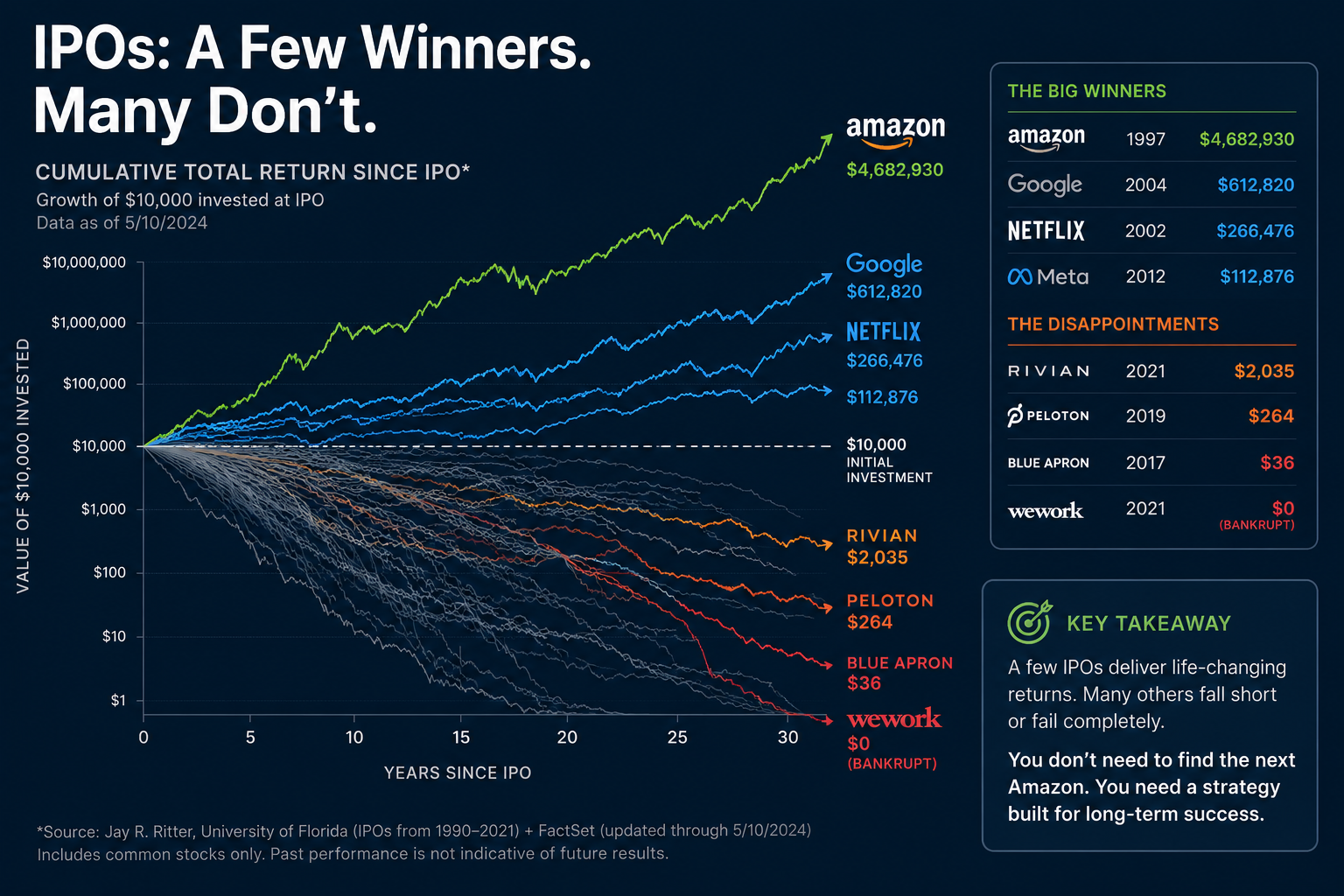
The challenge is that IPO outcomes are incredibly skewed. A few massive winners create the perception that IPOs are a great way to invest, while many others underperform or disappear entirely.
Amazon, Alphabet (Google), Meta Platforms (Facebook), and Netflix are examples of great IPOs that turned out to be great long-term investments after going public.
Then, are highly-anticipated IPOS that have led to long-term disappointment, like Peloton, Rivian, Beyond Meat, WeWork, Blue Apron, and many more.
One reason is simple: early investors and founders are often looking for liquidity. In other words, the IPO may represent an opportunity for existing shareholders to sell shares at favorable prices. Retail investors who buy in the first few days of trading may see the value of their investment fall as a result.
Another common reason is the company fails to meet earnings expectations after going public, get downgraded by analysts, and ultimately lose investor interest.
That doesn’t make IPOs bad investments. It simply means investors should approach them with the same discipline they would apply to any other investment decision.
Before investing in an IPO, consider:
• Is the company profitable?
• Does it have a sustainable competitive advantage?
• Are you buying because of the fundamentals or because of the hype?
• How does this fit into your overall portfolio strategy?
For most investors, a diversified portfolio of high-quality stocks and ETFs will likely do more to build long-term wealth than trying to predict which IPO becomes the next market superstar.
Successful investing is rarely about finding the next hot stock. It’s usually about consistency, diversification, tax efficiency, and patience.
Before chasing the newest opportunity, make sure it aligns with your goals, risk tolerance, and long-term strategy. Investing based on excitement can be expensive. Investing with purpose tends to be much more rewarding.
Wondering whether an investment opportunity actually fits your financial plan? At Life Moves Wealth, we help business owners and professionals evaluate investment decisions through the lens of taxes, risk, cash flow, and long-term wealth creation—not market hype. Reach out if you’d like a second opinion on your portfolio or investment strategy.
Disclosures
Life Moves Wealth Management is a registered investment advisor offering advisory services in the States of Arizona and Indiana, and in other jurisdictions where exempted. Registration does not imply a certain level of skill or training. Information contained on this site should not be considered a solicitation to buy, an offer to sell, or a recommendation of any security in any jurisdiction where such offer, solicitation, or recommendation would be unlawful or unauthorized.
The information on this site is not intended as tax, accounting or legal advice, as an offer or solicitation of an offer to buy or sell, or as an endorsement of any company, security, fund, or other securities or non-securities offering. This information should not be relied upon as the sole factor in an investment making decision. Past performance is no indication of future results. Investment in securities involves significant risk and has the potential for partial or complete loss of funds invested. It should not be assumed that any recommendations made will be profitable or equal any performance noted on this site.
HYPERLINK DISCLOSURE – The information being provided is strictly as a courtesy/convenience. When you link to any of the web sites provided here, you are leaving this website and assume total responsibility and risk for use of the web sites you are visiting. We make no representation as to the completeness or accuracy of information provided at these websites. Life Moves Wealth Management is not liable for any direct or indirect technical or system issues or any consequences arising out of your access to or your use of third-party technology, web sites, information and programs made available through this website. Life Moves Wealth Management does not make any representations or warranties as to the accuracy, timeliness, suitability, completeness, or relevance of any information prepared by any unaffiliated third party, whether linked to Life Moves Wealth Management’s web site or incorporated herein, and takes no responsibility thereof.

Author: Dale Shafer II, CFP®, CBEC®, APMA®


This website uses cookies to make sure you get the best experience on our website. You can find more information under the Privacy Policy.
