The largest wealth transfer ever has already begun and is expected to continue over the next 20-30 years. It’s been widely reported. Is it creating a larger sense of entitlement for the next generation(s)?
Earlier this week I offered the opportunity to comment on a story being written for a financial planning magazine. The reporter posed the question of how we’re advising business owner clients and their families around the topic of generational entitlement, positing that business owners who were once focused on growth are now thinking about legacy and continuity.
Generational entitlement is perhaps a topic of interest for anyone who has built wealth or is in the process of building wealth. Some want to leave as much as possible for the next generation. Some want their children to earn their own way. I’ve heard many versions of this in client conversations, particularly when addressing retirement income planning and estate planning.
There’s an old saying about generational wealth:
The first generation makes it. The second generation spends it. The third generation loses it.
While I could speak at length on this topic from different angles impacting wealth transfer, such as tax drag, creditor risk, investment planning, charitable planning, family dynamics and spendthrift protection, etc., I think we should first back up and look at great expectations.
Many of us grew up with the expectation that we would do better financially and maybe even professionally than our parents and grandparents. Technology, economic conditions, global trade, higher education pursuit, and even the side hustle culture are vastly different compared to how the world worked even 25-30 years ago.
I didn’t grow up with any expectation of wealth or inheritance and have always known I was responsible for building my own wealth and creating a legacy for our children going forward. Growing up in the 80s and 90s made the pursuit of wealth a high aspiration.
Culturally, we were blasted with the idea that cars and shopping and travel were the fruits of going to college and getting a high-paying job. Kids growing up in this century have not known a world without internet and social media. They see similar messaging, but a different path: driving a Lambo, flying private to Dubai, and reaching billionaire status are the fruits of being an influencer, trading crypto, and now using AI to start side hustles.
I don’t mean to be cynical, but their world is a bit different than the one before them. For those who have built solid careers with higher incomes and some wealth accumulation have established a certain lifestyle level that our kids have come to expect as a baseline for what their lives should look like in early adulthood.
If they aren’t making $200k right out of college, bought their dream house by age 25, and didn’t travel to Europe for spring break, they may feel like failures.
If you’re reading this and shaking your head, I feel that. But still, this is the world we’ve created for them.
In a recent exchange with one of our kids, we joked about this expectation:
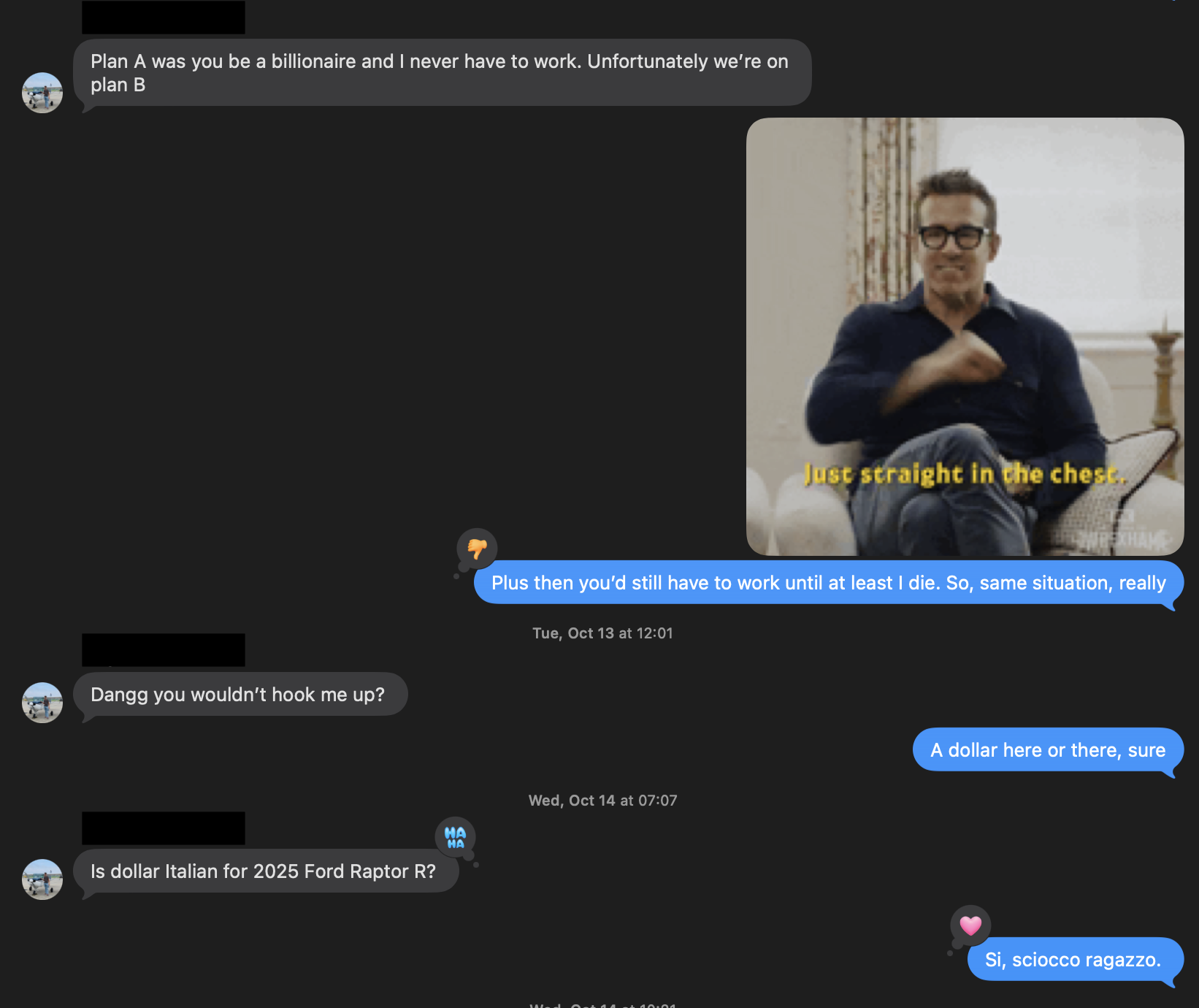
Our kids have grown up squarely in a middle class environment; not wealthy, not disadvantaged. Always had what they needed, a good bit of what they wanted, and with a priority on experiences over stuff. They’ve seen us work hard, they’ve been part of decisions, and they understand that we’re positioning to help them both during and after our lifetimes.
I don’t know if there will ever be a “B” behind my name, but we can all dream of unlimited resources and a lavish lifestyle, right?
I remember a poster I had on my wall as a kid—a white Countach parked outside of an oceanside flat roof mansion with mountains in the backdrop. Right next to the Metallica poster. Rockstar lifestyle. Californication.
And, what adventurous young person living in the southwest wouldn’t want to drive a Ford Raptor off the highway and straight into the desert? Certainly more practical than a Lambo, I suppose. Maybe we got something right in that regard. 🙂
Managing great expectations, or entitlement, is an ongoing conversation that should happen within a family. When a business is involved, it becomes even more important to create teaching moments so everyone understands that a successful business now was at one point a very real risk someone took; the same business tomorrow becomes a very real risk for someone to continue into the future.
When the business is treated as an asset, rather than just a high paying job, stewardship and care for that asset must become the mindset that is transferred… not just the income or eventual wealth that asset currently provides. The same is true of real estate, trusts, inherited IRAs, and any other transfer of value.
What good is inheriting something if there’s a high risk of mismanaging and losing it altogether? Communication, involvement, and participation help manage expectations and ultimately can be a good defense for entitlement.
What are your thoughts on this subject? How have you worked to manage entitlement in your home and business?

Author: Dale Shafer II, CFP®, CBEC®, APMA®


This website uses cookies to make sure you get the best experience on our website. You can find more information under the Privacy Policy.
