Your portfolio should have a well-defined job description.
Every dollar we invest is tied to a goal, a timeline and the amount of volatility you can live with. Before we pick a single fund, we put the rules in writing in your Investment Policy Statement.
Each portfolio is built from four blocks, each with a specific job.
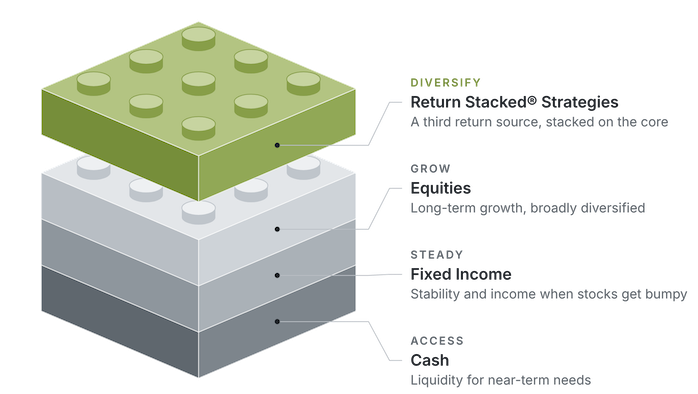
Most portfolios rely on two sources of return: stocks and bonds. Return stacking adds a third source on top of that core. Because of how return-stacked funds are built, adding this layer doesn’t mean selling stocks or bonds to make room for it.
Why does a third source matter? In 2022, stocks and bonds both fell by double digits, and the usual cushion disappeared when investors needed it most. A layer that has historically moved independently of both aims to lower volatility and help the portfolio hold up in more kinds of markets.
We trade on rules, not feelings.
Rebalance when any asset class drifts more than 5% from its target. That means trimming what ran up and adding to what lagged. Adjust when your life changes: a business sale, a new job or a shift in income. Plan taximpact before every trade.
Having a defined discipline protects us from being reactionary so that a scary week or a hot new stock doesn’t trigger an emotional trade.
If your investments feel like a collection of accounts instead of a strategy, let’s talk.
Investing involves risk, including loss of principal. No strategy guarantees a profit or protects against loss. Return-stacked strategies use derivatives and leverage, which can amplify gains and losses. Past performance does not guarantee future results.


This website uses cookies to make sure you get the best experience on our website. You can find more information under the Privacy Policy.
